Showing posts with label cycling infrastructure. Show all posts

07 September 2012

Isaak Kornelsen Deserved Better.

Video from the beautiful Critical Mass memorial Ride For Isaak by Andriko Lozowy, via YouTube.

Others have written much more eloquently than I can manage about the tragic, horrifying death of 21-year-old Isaak Kornelsen, who lost his life while cycling on Whyte Avenue in late August, and the infrastructure deficit that put him in danger. I refer you to their posts:


My heart breaks for Isaak Kornelsen's family and many friends, and I feel I am poorer for not having known him. Certainly the world is poorer without him. 

I still feel ill whenever I think of the accident - and the ignorant, callous, victim-blaming comments I have seen made in certain quarters. The attitude that cyclists and pedestrians are inconveniences and obstacles to legitimate road traffic, instead of real people, particularly upsets me. Some have suggested banning the use of bicycles on Whyte altogether, and forcing cyclists to use the side streets, which misses the point that road safety is about making streets safe for everyone, not removing vulnerable users from them. I'm convinced that adding off-street parking in the form of another parkade and using what is now a parking lane to create a separated bike lane along Whyte Avenue would be a win-win for cyclists and motorists. If only it didn't take a 'freak accident' completely preventable death to catalyze these important conversations about road safety and incomplete infrastructure.

(Isaak Kornelsen was not the only Edmontonian to needlessly lose their life while on a bicycle this year, although his death is being more widely mourned. While on a cycling vacation with her husband in July, 63-year-old Elizabeth Ann Sovis was struck from behind by a van driven by a man with multiple prior convictions for drunk driving. Follow up reports stressed that she was a cautious bicyclist, and Cycling PEI held a small memorial ride for her. The narrow, shoulderless country roads of PEI probably won't get any infrastructure upgrades, despite the promotion of the province as a cycle touring destinationThe driver will go to trial this autumn. Ms Sovis was a French teacher, close to retirement, and her death has played out as a private tragedy because of her age and the location of her accident - but it was just as preventable.)

04 August 2011

Ballard Greenways

If you've talked to me in person in the last few months, you've probably heard me talking about Neighborhood Greenways*. To crib from a previous post "These are quiet streets that give priority to cyclists and pedestrians, while still allowing motorized traffic at lower speeds. They're for people who don't want to ride on the busy arterial streets, but still need to go somewhere".


A group of folks in the Ballard neighborhood of Seattle have been meeting to discuss Greenways, why we think they would be great for Ballard and how to organize to bring it about. We now have a name - Ballard Greenways** - and a facebook page.

Last Sunday, I organized a group ride to tour some of our proposed routes and to start promoting the idea to the community. We timed it to finish at the Summer Field Day, a kids' event featuring outdoor games and races at a local park. A couple of neighbourhood blogs were good enough to post about the ride (Thanks MyBallard and Totcycle!), which brought us a few new folks. There was a steady drizzle all morning and I was concerned that I might have to cancel. However, the rain stopped midday, so the ride was on.
Chatting about the route as we wait for everyone to arrive.

This was the first time that I had brought Spencer for a group ride. He was very interested in this little girl in her trailer.

Spencer found it hard to resist touching everyone else's bikes. Resist? Who am I kidding? He didn't even try. Clearly, this will take more discussion and coaching before I try it again. However, once we got on our bikes and got rolling, he did great.

I'm afraid I don't have any photos from the ride itself. Leading the ride, watching Spencer, and talking about routes took all of my attention. Next time, I'll have to pass the camera on to someone with a free hand. However, it went really well. There were good discussions about the advantages and disadvantages of different routes. We were treated to a little local history about an old theatre and the old bus and streetcar routes.

I know we'll have to be patient and that this will take a lot of work. The group rides and discussions over a beer are pure fun, but the serious organizing is just beginning. Still, I'm really excited to see how many people are enthusiastic about bringing better and safer infrastructure to our neighbourhood.

*After 10 years in the US, my writing is a random mixture of Canadian and American spellings.

**Cause we're creative like that.


This is my group ride entry for the LGRAB Summer Games 2011.

07 July 2011

Margin of Error


What makes good infrastructure? One key feature is that it is forgiving. Infrastructure that requires expert skills and an absolute focus is crappy infrastructure.

Photo courtesy of Michael Snyder via SeattleBikeBlog.

A recent example of this can be found on the Burke-Gilman Trail. This is the grandaddy of multi-user trails in Seattle. It's a major route for bicycle commuters during the week and is thronged with the kids & dogs crowd on the weekend. It's one of my favourite parts of Seattle. However, it does have its flaws, including a spot near NW 41st St. where the trail crosses railway tracks. The trail does try to indicate that cyclists should cross at a 90 degree angle, but the natural path to take is a shallow angle that places cyclists at considerable risk of catching a tire on the track and falling. To try to improve safety, a rubber mat was installed. This does prevent catching a tire, but can become very slippery itself when it's wet or frosty. Not surprisingly, this has been the site of many accidents (well covered by the Seattle Times and SeattleBikeBlog) and I'm happy to hear that SDOT is fixing it.

The response to the story has been fascinating. At some point in the comments, you'll typically see an exchange like this:
  • People ride too fast there! I always slow down enough and cross at a 90 degree angle and I've NEVER had a problem
  • Well, I'm a VERY experienced cyclist and have crossed that spot thousands of times without a problem before falling and breaking my arm!
  • People have to learn how to cross railway track safely. Slow down and cross at a perfect 90 degree angle!
Now, I'm all for safety, and hearing about these accidents certainly reminds me to be careful when crossing the tracks. I also recognize that the city can't find and correct every hazard out there, whether it's gravel, potholes or wet leaves. However, I think people tend to miss the point. When we build and design infrastructure, we can't assume that everyone using it will be highly skilled. We also can't assume that those who are skilled will be paying perfect attention at every moment in time. Our brains do not work this way. We all get distracted by things we see on our way, personal issues, or even thoughts of dinner. If a spot is particularly risky, you can do everything correctly (which we often don't) and still have a significant chance of falling.

If our infrastructure demands perfection, it's only a matter of time before we'll fail. Good infrastructure allows for some margin of error. We demand it in the design of our highways and cars - let's also demand it in our bicycling infrastructure.

28 June 2011

Gender Gap?

There's a fascinating discussion going on in bike-blog-land as a result of Elly Blue's Bicycling's Gender Gap post at Grist. She makes an interesting argument that the gender disparity in ridership figures could be a result of economic disparity and additional caregiving and household duties, in addition to the 'fear and fashion' theories - and points out that both cycling infrastructure and appropriate, affordable bikes for carrying kids and cargo are missing in most North American cities. The lively comment section is well worth a read, with additional points about racism, class-ism, street harassment, and public perceptions of cyclists being made. It's also well worth going back and reading the rest of the series of articles, which includes some especially salient points about political pressure to keep the status quo and the actual costs of freeways. The author also followed up on her own blog. Meanwhile the discussion has spun off onto one of our favourite bicycle blogs, Velo Vogue. Go read the links and meet me back here, mmkay?

You've read it now? Good stuff, right? If a bit counter-intuitive based on the explosion in lady-bike availability and number of women writing fantastic bicycle blogs.

So, instead of debating which is the most important, let's say that all those factors are at play in preventing women from riding at the same rate as men do in North America - which they probably are, to some extent. How can we fix that? How do we encourage more ladies to get on their bikes? Can bike blogs like ours, and the social rides and bikey events organized by blogs like ours, actually make a difference?

Angel (my Loop-Frame Love coblogger) and I probably aren't typical cycling activists (if such a person exists). We're moms with 2 young kids each and minivans and small budgets who live in the suburbs - and we'd love for this blog to (eventually) demonstrate that it's possible to live car-light under those circumstances, if not completely car-free - like our blogging heroes at Carfree With Kids, Car Free DaysChicargobike, full hands, mamafiets, and Totcycle are already doing on their blogs for their circumstances. So let's be honest about the barriers we face to doing that, and how they relate to the factors mentioned above.

(Our coblogger Jen's situation differs from ours in that she's living in a more central neighborhood in a different city, has one child, and is still commuting to full-time work instead of staying home or working part-time... so we hope she'll chime in in the comment section.)

My favourite current setup for easy kid-hauling is the Bobike Junior seat on a Raleigh-built 3-speed (Ms. Trudy Phillips),
but my 8-year-old is a bit too big for the seat and the pretty wicker basket will only hold a small bag of groceries.
We're pretty lucky in a lot of ways. We're middle-class white Canadians, so our experiences are fairly sheltered. Our husbands are not themselves cyclists, but are happy to support our interest in cycling. We're part of a bigger local community of cyclists, advocates, and bike bloggers who are demonstrating through their daily lives and organized rides just how much fun life on two wheels can be. We're social creatures, so it's probably important in helping us stay motivated that we have that support system.

We live in a city with progressive urban planners who are in the process of improving the infrastructure for public transit and active transport, and we live in neighborhoods that have multi-user paths and/or sharrowed bike lanes that we can safely ride to useful destinations. However, we also live in the closest big city to the Oilsands, in a politically conservative part of Canada, in a place where a large proportion of the automotive vehicles using the roads are pick-up trucks and sports utility vehicles. So, when we venture outside the MUPs and sharrows, we don't always encounter drivers who are predisposed to be kind to bicycle users. We have been buzzed and yelled at. We totally understand when our friends who haven't ridden since their teens ask hesitantly about traffic on the route for the next Critical Lass. That said, the infrastructure in our neighborhoods has made that a pretty minor concern for our day-to-day rides.

We're also really lucky to be part of a community with an amazing not-for-profit (EBC) that makes it possible to buy a low-cost vintage bike and turn it into a safe, reliable ride we can wear our regular clothes on; but turning it into a grocery-getter and a good way to get young children from A to B can be a bit of a challenge. We still wish we could get our hands on a longtail or cargo bike without having to blow our budgets. Going car-free so we can increase our bicycle budgets is not in the cards for our families, and we're both still figuring out how we can run bike errands with two kids in tow, since neither of our eldest children are strong solo cyclists yet, despite being too big to be passengers. We'll be actively working on that during the summer holiday from school.

We can testify that how busy our day is and how pressed for time we feel does directly affect how much (or how little) we ride. A quick run to the grocery store without children for a few items is easily managed by bike, but multiple errands with the kids becomes an all-day adventure when you're not properly set up to do it by bike. A longtail or cargo bike would make that much easier, but ferrying the kids to extracurricular activities in other parts of the city immediately after school still would require a car because of the distances involved. If we were commuting for work, public transit would probably be more time-efficient than cycling, because we both live walking distance from major suburban transit hubs (As it happens, my husband has found that taking the LRT downtown is usually quicker than driving, and more pleasant.). So, ability to use our bikes while caring for our children and living our busy lives has been our single biggest barrier to riding more.

Your turn, my friends. What's your single biggest barrier to riding more? Which barriers do you feel apply to your friends (of either gender) who don't use their bikes? How can bike bloggers and cycling advocates help remove those barriers?

Update: I've just been reading Velouria's post on Lovely Bicycle about the different kinds of bicycle commuting, and I wonder how the study that's being discussed accounted for office-job commuters versus freelancers and errand-runners, and how gender might skew which category you fall into?


Update 2: You need to also check out LGRAB's new series of guest posts on commuting by novice cyclists, the first of which was just posted - they'll be talking about their barriers and how they surmounted them, too! I love the ideas from the current post of learning to bike commute in steps, and seeking out social ties to the activity so you have friends and role models. 


3rd July, Update 3: We've been invited to crosspost this piece on the perfectly wonderful blog Lindsay's List, which has necessitated a slight rewrite and the addition of a shout-out to a few of our car-free-and-car-light family blog heroes. I'll also be adding a photo that wasn't originally included, of my current setup, once it's been taken.


10 July, Update 4: http://lindsayslist.org/2011/07/gender-gap/ It's up!

19 June 2011

The Magic Stoplight - Updated

Update at the bottom:

One of the key aspects of creating walkable and bikeable neighbourhoods is to funnel traffic onto arterial streets and use traffic calming measures on the residential streets. For the most part, this seems to work pretty well in my neighborhood. Frequent speed bumps and traffic circles keep traffic speeds low and discourage cut-through traffic. The streets are narrow and tree-lined, making it pleasant for walking. It's quiet enough that I can give my son a little more freedom and let him run or bike to the corner on his own, though he still needs to wait for me to cross the street. It's a pretty comfortable environment for novice cyclists as well.

Until...you reach the arterials. These busy streets have high traffic volumes and speeds and often no safe way across for pedestrians and cyclists. If there is a street light, it's only triggered by the presence of a car on the secondary street - a cyclist can wait until nightfall without getting a green light. These arterials effectively form a moat or wall, separating my neighbourhood from parks, stores, friends - all the places that I want to use my bike to get to. Now, when I'm riding on my own, I can watch the traffic and usually find a gap between the cars that is big enough to dash across the road, even if it is a little hair-raising. When riding with my son, though, I was forced to either make a substantial detour to find a friendlier crossing or to dismount, hop up onto the sidewalk and press the button to trigger the pedestrian signal. Both options are annoying.

Last fall, my world changed. I discovered the Magic Stoplights. When a secondary street crosses an arterial, the city of Seattle typically installs an induction coil. If a car is waiting, the metal in the car triggers the switch, changing the light on the secondary street from red to green. In the photo below, you can just see the circular cut in the pavement where the induction coil was installed. What I didn't know is that a bike can trigger also trigger the switch! Because a bicycle has so much less metal than a car, position is key. You have to place your front tire on the little white T, approximately at 9:00 or 3:00 on the circle.


Placing a bike wheel on the "T" triggers the green light.

SDOT has recently changed the marking to the cute little cyclist shown below. I haven't seen any in my neighbourhood, but I have spotted one or two around the city.


Photo courtesy of Seattlebikeblog.com

This seems so simple, but it makes a world of difference in finding safe, convenient routes to our destinations. It's a great compromise, allowing safe crossings to cyclists, while maintaining good traffic flow on the arterials.

The main gap now is publicity - far too many cyclists have no idea what the markings mean. Every time I see a cyclist waiting for the light at the wrong spot, I make a point of telling them how to do it. I'm on a mission to spread the word!

Update: I was as at a neighbourhood meeting last night and chatted with a real, live traffic engineer. Apparently, the little white T marks the position of the induction lead, so positioning yourself on the opposite side of the circle won't work. Also, he recommended placing the crank over the T, as that's the part of the bike with the most metal. If you have a steel frame, it probably won't matter, but if you have a carbon fork, the front wheel may not have enough metal to trigger the switch. I tried this on my way home, but, alas, I found I couldn't trigger the switch no matter what I did. I've wondered about that particular intersection before, but there are always enough drivers and pedestrians around during commuting hours that some one always triggered the light before long. Looks like I'll have to call SDOT on Monday.

11 May 2011

Neighbourhood Greenways

How do I get there? How do I find a route that feels safe but is still reasonably direct and, if I’m really lucky, enjoyable? Recreational bike paths are great fun, but don’t really help you when you just need to get around town. Many city bike lanes are on busy arterial streets that can be intimidating to potential cyclists and are not particularly family-friendly.

Enter the Neighbourhood Greenways (previously called Bike Boulevards). These are quiet streets that give priority to cyclists and pedestrians, while still allowing motorized traffic at lower speeds. They’re for people who don’t want to ride on the busy arterial streets, but still need to go somewhere. I’ve been a seasonal bicycle commuter for the last couple of years, and am moderately comfortable in traffic. However, when I make short neighbourhood trips, I prefer a low key route, particularly when towing my 5 year old on the trail-a-bike. It’s a dramatically different experience – I’m much slower and less agile with the trail-a-bike and ride much more conservatively. For instance, I need a much larger gap in traffic when crossing intersections.

The Neighbourhood Greenway idea is gaining momentum here in Seattle. Last week had some terrific blog posts describing both the concept and details of the campaign to bring them to Seattle:


Much of NW Seattle (including the Ballard, Greenwood and Crown Hill neighborhoods) should be well suited to this. The streets are laid out in a reasonably regular grid. It’s relatively flat, by Seattle standards, at least until you reach Phinney Ridge. Traffic calming measures, such as traffic circles and speed bumps, are already common to reduce speeds on residential streets and funnel through-traffic onto the arterials. The above photo is of a typical residential street in this area. It’s narrow – allowing parking on both sides of the street means that only a single car can pass at a time. This is actually an advantage to cyclists, as drivers are already used to going slow and taking turns to let each other pass.


Traffic circles, like the one above, dramatically slow vehicle speeds. Frankly, it’s annoying to drive around more than one or two at a time. In contrast, bikes can pass by them with only a slight curve – they’re really a piece of cake.

So, what’s special about a Neighbourhood Greenway? How is it different than just riding on the residential streets already there?

1. Priorities at intersections. Currently, it’s difficult, if not impossible, to cross arterials without a traffic light.

2. Signs and paint to make it clear that this is a pedestrian and cyclist-friendly space.

3. Promoting a network. I think it’s great that folks in Seattle are thinking in terms of a network of Greenways - that's key to making them useful on an everyday basis, as opposed to a once-a-month recreation or novelty. This also presents novice cyclists with clear routes to reachable destinations. Such a contrast to the current situation where every new cyclist has to figure it out for themselves.

Over the next couple of months, I plan to ride many of the proposed routes to get a feel for the advantages and disadvantages of the different options. Along the way, I’ll post a few photos and my thoughts on the plans.

12 October 2010

Exploring the Sharrows in Millwoods

We've been wanting for awhile to do a ride where we go explore the roads with the new sharrows in Southeast Edmonton, which have been installed painted this year as part of the implementation of the City of Edmonton's Bicycle Transportation Plan. Weddings and illnesses have intervened, but we finally got a chance this weekend, while turkey was in the oven and warm sunshine tempered the autumn winds.

We rode from Angel's place to her son's elementary school, followed the sharrows partway along the Millwoods Road loop in light traffic, then ducked down 66th Street (which is busier and has no markings) to warm up with coffee at Millwoods Town Centre. I definitely felt like the drivers on 66th were more impatient than those we encountered on the marked section of our route.


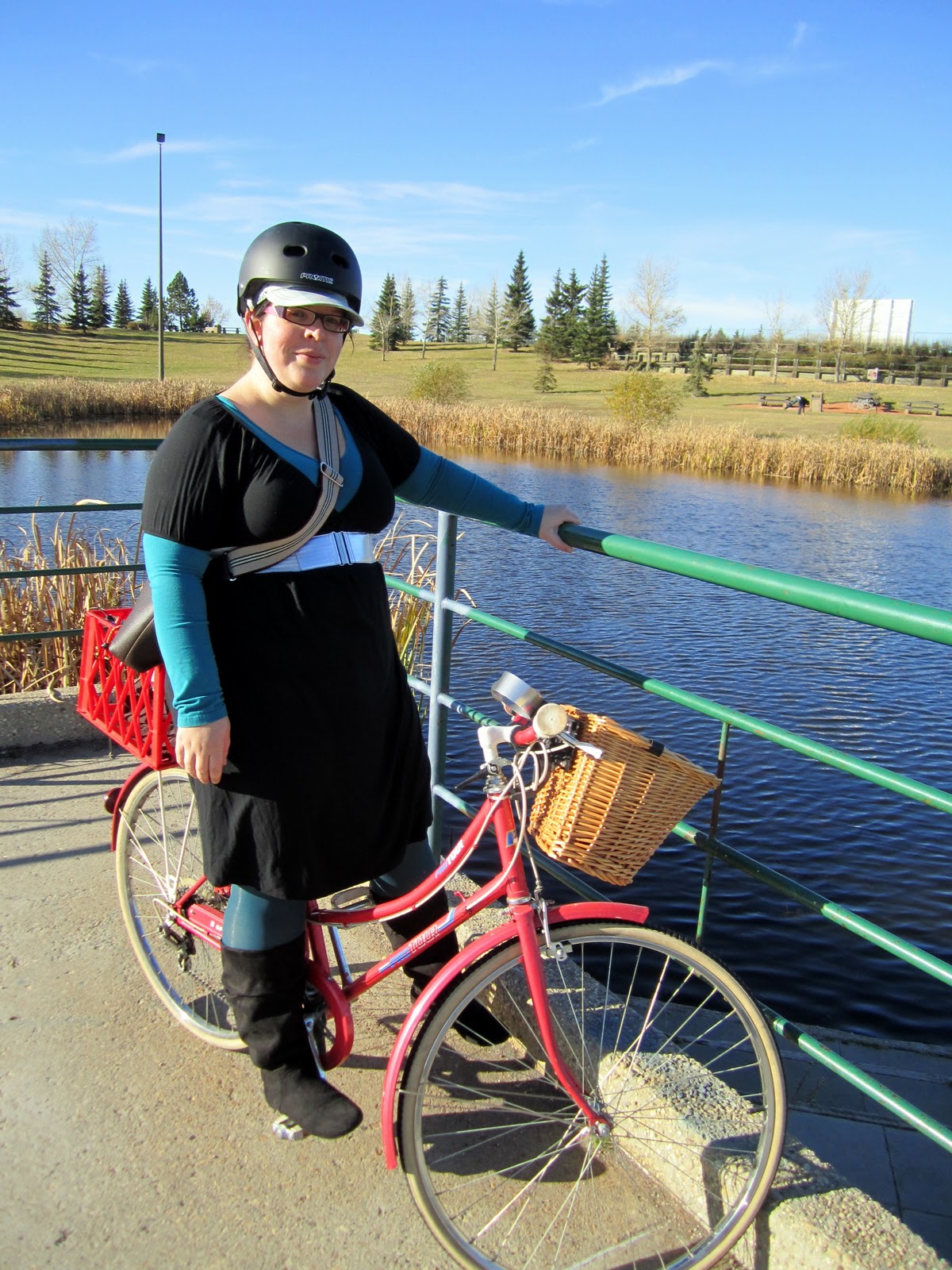
Angel has fantastic new slouchy suede boots and shiny teal tights.


The idea is that you ride square down the middle of each sharrow marking, 
but that makes it trickier to photograph them.
(When you ride over these fresh ones, unlike the older ones around the U of A,
you feel a gentle bumpity-bumpity-bump under your tires from how thick the paint is.)


A better view of an entire sharrow marking, taken with the camera at handlebar level.


Most of the way along Millwoods Road, the markings are in the middle of the lane, as seen here. 
However, there are also a couple of sections where they were placed (like a bike lane) closer to the curb,
and then cars had parked over top of them (which makes them considerably less helpful). 


The roads with sharrows also have signs like this one, reminding drivers to expect bicyclists in the lane.

Coffee was lovely. I had chai and a poppyseed roll, mmm.
Since the chain cafe where we stopped had no bicycle parking (shame!), 
we sat outside in the sunshine at a table beside our bicycles. 
The cafe could definitely use a rack, since there were three other bicycles parked beside ours.


Our next stop was Millwoods Park. We took some portraits:


Angel and Daisy
Angel complained that the wind was trying to flip up the hem of her stretchy jersey dress while she rode,
but she looked so comfy and colorful. Not to mention badass, in this shot.


Deborah and Mary Poppins


Vintage herringbone wool shift dress, herringbone patterned tights, and vintage Naturalizer pumps.
I like to imagine that the pumps were nurses' shoes in their previous life. 
I think in the future I'll wear this dress with leggings instead, 
since it had a tendancy to ride up as I pedalled, 
but the wool was the perfect weight for 13C with a cool breeze.

After Millwoods Park we swung down 26th Ave to peer through the window of an LBS I had noticed.
Then it was back via the road past Grey Nuns Hospital, and a residential street with great Hallowe'en decorations already being put up, to Angel's to chill out.