Showing posts with label Seattle. Show all posts

24 November 2011

Kidical Mass rides in Novembrrr!

After following the Totcycle blog for a couple of years, I finally had a chance to join his Kidical Mass ride last week.  The occasion was the grand opening of the Ship Canal Trial. It's a great piece of bike infrastructure as it lets people get from Magnolia and the Ballard Locks to the Fremont bridge, without having to take a confusing and not-particularly friendly interchange near the Ballard Bridge.

The forcast was for chilly, with a possibility of rain and/or snow. Chilly by Seattle standards, of course, which translates to 35-40F (2-4C). I hadn't taken Spencer for a winter ride before, and I was a little concerned about how to dress him. I started digging through the closet to find last year's winter gear. The snow pants fit great, but were probably unnecessary. Tried to find toques without pompom that would fit under bike helmets. The good mitts were left at karate class. And Spencer's winter coat looked awfully short in the sleeves. This is when I began to feel like a lousy mother and a lousy Canadian. Didn't I know that winter was coming? Has it ever skipped a year? In the end, the best solution was to wear last year's coat and a warm pair of my mitts that were long enough to cover his wrist, even with the somewhat too short sleeves. Extra sweaters, scarfs and toques were added, I packed the pannier, and we were ready to roll.

When we got to the end of the driveway, it became clear that I had overreacted and we were both terribly overdressed. So, we stopped to strip off layers, and my pannier was then stuffed with fleece for the rest of the day. Still, I'm glad we had the mitts and scarf - little bodies get cold quickly. Especially, when they don't help much with the pedaling. Finally, we were on our way and were only a little bit late to our meeting place at the Ballard Library. 

Spencer was ready to go.
Despite the chilly weather, there was a great turnout. I didn't get a complete head count, but suspect it must have been about 40 people. And the bikes! There were at least three Madsens, one Bakfiet, a couple of trailers and two trail-a-bikes. Clearly, this was a very bikey crowd.


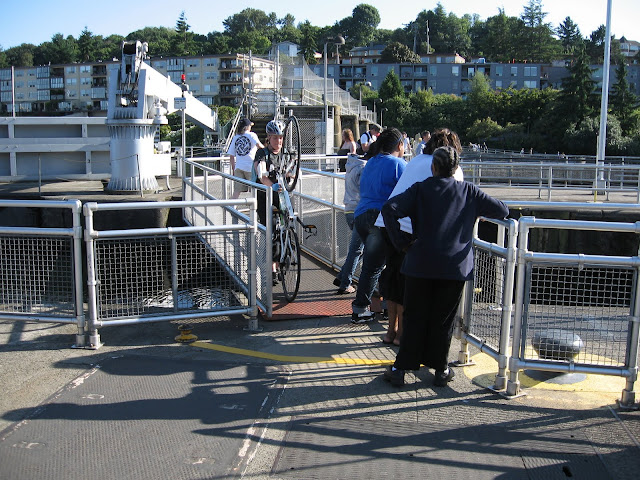
We rode west on NW 57th St., one of our candidates for a neighborhood greenway. It's always fun riding with such a big group. We can chat with folks, admire the different bikes and swap stories. Of course we're still careful about traffic, but we don't really have to worry about visibility with a group of this size! We took 28th Ave NW and then Market St. to the Ballard Locks, where we had to dismount to cross the canal. There is no denying that this was a production. The walkways across the locks are relatively narrow - there's just enough room for a bike and pedestrian to cross each other. A group of cargo and family bikes takes a long time to cross. Fortunately, traffic was very light - there aren't many tourists out on a chilly November morning.


The locks were still pumped dry for their annual maintenance. We could see a few folks working away at the bottom, which gives a sense of how big it really is. The barnacles clinging to the wall were starting to get rather stinky by this point. It didn't seem to bother the crows and gulls, though - they were still enjoying their sushi.

See the three white dots? Those are the workers in their white hard hats.
After many photos and three separate bathroom breaks, we were finally ready to continue on our way. We rode along Commodore Way and through Fisherman's Terminal. It's a light industrial area without a bike lane, but the road is relatively wide and there was hardly any traffic. We arrived under the Ballard Bridge just in time for the opening ceremony. A good sized crowd of cyclists and walkers had gathered by this time.


Peter Hahn, the head of SDOT, gave a speech and cut the ribbon with very big pair of scissors.


However, for our group, the big attraction was Julian's thermos of hot apple cider to warm those chilly fingers.


Before too long, we were on our way. I don't have any photos of the new trail, yet, but there's a nice one here. It's a pleasant ride that I'll definitely check out again and will be my preferred route between the Pier 91 trail and the Fremont Bridge. However, there is a rather annoying double 2-curve to cross the train tracks. I know they need to slow bike traffic down and direct folks to cross at a right angle, but this really seems excessive. Still, it's a minor flaw in an otherwise great trail.

After crossing back across the Fremont Bridge, we split up to get food and then met again at the Fremont Brewery. This was my first time there, and I'm delighted to discover such a cool place. It's a local microbrewery which makes absolutely delicious beer. It's a tasting room, not a full-fledged bar and they don't sell food, but allow you to bring your own it. It's really a big room with picnic tables at one end and big, shiny vats at the other, but seemed cosy and friendly. It's also remarkably family-friendly - they even have a couple of baskets of toys! Only in Seattle. Sadly, I have no good photos from this part of the trip, so you'll have to take my word for it until you can go there yourself.

After food, a beer and lots of chatting and tracking down stray children, it was time to go. We'd had a full day and I knew we were in the pre-melt down phase. Plus, Spencer was getting tired too. We weren't the only ones who'd had enough. Thirty seconds earlier, this little guy had been flopped over the edge of his bucket seat. If only I'd been able to get my camera out earlier.....


It was a great group and a terrific ride. I hope we can do it again soon! And I did buy my son a new winter coat the next day.

26 September 2011

Moving Planet Seattle


Saturday was the Moving Planet Seattle Event. The theme was transportation, so it was fitting that folks met around the city for group rides to Lake Union Park. About 20 of us met in Ballard for the ride, including three families.
Our trail-a-bike.

A kindred spirit had an Xtracycle.
A tandem bike completed the set.
Our fearless leaders set the pace in the awesome, traffic-stopping conference bike from the Dutch Bike Company. This beast is mighty, but slow and a tad too wide for the trails. So, we took a traffic lane and made a slow parade to Lake Union Park, with enthusiastic waving and bell-ringing at passersby. Once there, the group dispersed to explore the different events, though we did run into each other throughout the day. Metaphorically speaking, that is.
The conference bike in all its glory.
The Center for Wooden Boats had wooden sailboats for kids to play with on the boat pool. Spencer was so excited to see the boats, that I could barely get him to leave long enough to lock up our bike. We probably spent 20-30 minutes there.

I was more excited to see this bike, which looked suspiciously familiar....

After looking around for likely suspects, I took a deep breath and asked "Hey, are you the Family Ride blogger? I recognize your bike." Yes! It was Madi from Family Ride, who was friendly, charming and  happy to talk about bikes, boats and kids. She asked if I'd been on some of the Totcycle rides, because I looked "sort of familiar". After a minute, she realized that she'd seen us here on the blog. That, my friends, is the kind of fame that blogging can bring you! 

Jennifer and Madi, who both looked "sort of familiar".
Spencer eventually had his fill of the boats, so we wandered off to see more sites. Along the way, he was caught by the plastic bag man. The costume was made from 500 bags, but he'd lost a few along the way. Kids just couldn't resist trying to pull them off. At least, my kid couldn't. And I did make him stop and give them back.


There was a great kids' craft table, which spawned many masterpieces. A fish doesn't need a bicycle, unless, of course, it's a bicycle powered by cocktail umbrellas.

I was delighted to run into my friend Arvia. The folks at the family bike expo talked her into taking the kids for a spin in this:
I tried it out as well. It was reasonably easy to pedal, at least on flat pavement, but quite tricky to turn. It has an extremely wide turning radius and you end up leaning over ridiculously far. It felt like I was about to fall over, but it's really quite steady. Not exactly a practical bike for most people, though. 

Some bikes were made just for fun:

More crazy bike-like objects.
Oh, yeah, there was also a rally:
Mike McGinn, Mayor of Seattle
We listened for a while, but when Spencer tried to take a nap in my lap, I knew it was time to go. All in all, it was a great event on a beautiful day. The organizers did a good job of combining fun, family activities with real activism and awareness, a tricky thing to balance.

04 August 2011

Ballard Greenways

If you've talked to me in person in the last few months, you've probably heard me talking about Neighborhood Greenways*. To crib from a previous post "These are quiet streets that give priority to cyclists and pedestrians, while still allowing motorized traffic at lower speeds. They're for people who don't want to ride on the busy arterial streets, but still need to go somewhere".


A group of folks in the Ballard neighborhood of Seattle have been meeting to discuss Greenways, why we think they would be great for Ballard and how to organize to bring it about. We now have a name - Ballard Greenways** - and a facebook page.

Last Sunday, I organized a group ride to tour some of our proposed routes and to start promoting the idea to the community. We timed it to finish at the Summer Field Day, a kids' event featuring outdoor games and races at a local park. A couple of neighbourhood blogs were good enough to post about the ride (Thanks MyBallard and Totcycle!), which brought us a few new folks. There was a steady drizzle all morning and I was concerned that I might have to cancel. However, the rain stopped midday, so the ride was on.
Chatting about the route as we wait for everyone to arrive.

This was the first time that I had brought Spencer for a group ride. He was very interested in this little girl in her trailer.

Spencer found it hard to resist touching everyone else's bikes. Resist? Who am I kidding? He didn't even try. Clearly, this will take more discussion and coaching before I try it again. However, once we got on our bikes and got rolling, he did great.

I'm afraid I don't have any photos from the ride itself. Leading the ride, watching Spencer, and talking about routes took all of my attention. Next time, I'll have to pass the camera on to someone with a free hand. However, it went really well. There were good discussions about the advantages and disadvantages of different routes. We were treated to a little local history about an old theatre and the old bus and streetcar routes.

I know we'll have to be patient and that this will take a lot of work. The group rides and discussions over a beer are pure fun, but the serious organizing is just beginning. Still, I'm really excited to see how many people are enthusiastic about bringing better and safer infrastructure to our neighbourhood.

*After 10 years in the US, my writing is a random mixture of Canadian and American spellings.

**Cause we're creative like that.


This is my group ride entry for the LGRAB Summer Games 2011.

30 July 2011

All Summer in a Day

This spring and summer has been unusually cool and cloudy in Seattle. (You don't believe me? Cliff Mass has scientifically proven it!). Finally, Thursday was sunny and warm, making it a perfect day to take photos of my summer commute for the LGRAB Summer Games.

I cross Salmon Bay at the Ballard Locks. Cyclists have to dismount and walk across, but it's worth it. It's the best route across the water on the west side of Seattle. Early in the morning, it's quiet and serene.


The light industrial area of Magnolia and Interbay is better for cycling than one would expect, as the roads and bike lanes are wide, but the traffic volume is relatively low. Plus, you can see trains! On sunny summer days, the number of cyclists increases dramatically.


Down the road, I pass the place where school buses go to sleep. During the school year, they'd already be on the road. In the summer, you can see them lined up by the dozen.


Finally, I reach the waterfront. This is the prettiest part of my commute. I even take a small detour, just to spend a little more time here.


The wild roses remind me of my time in Edmonton. Their scent mixes with the salty, fishy air in a way that is strangely familiar yet different from Edmonton's background of trees and grasses. You don't have to stop to smell the roses, but it's probably a good idea if you want to take a picture of them.


On a clear day, Mt. Ranier appears to float above the horizon. We'll need to have a lot more sunny days before I can take that view for granted.


By the time I am on my way home, the city has woken up and is outside playing. The Locks aren't so serene now - cyclists and tourists continually thread past each other on the narrow walk way. I've said "excuse me" to people from many countries, given directions to the fish ladder, and explained that "yes, cyclist ARE allowed here. It's actually an important route". Being patient doesn't take much work - after all, we all want to be outside a little longer when the weather's so nice.


And that is my summer commute at its best!

12 July 2011

Bicycle Sunday

On Sunday, Spencer and I set out on the trail-a-bike for a bicycle adventure. Bicycle Sunday is a program run by Seattle Parks, where Lake Washington Boulevard is closed to car traffic on summer Sundays. The weather was good and our schedule was clear, so we decided to try it out for the first time.
Technically, this is not a panda shot since we are beside our bikes, not on them.

Lake Washington Boulevard winds gently along Lake Washington with parks on one side and attractive houses on the other. It was a fun, family crowd, with trail-a-bikes, trailers, training wheels, and wobbly new-to-two-wheelers.
Friendly people from the Cascade Bicycle Club were out, selling and fitting helmets for new riders.
Neighbourhood kids had a lemonade stand. I don't know how much business they did that day, but it was certainly a hit with my kid.
Now, Spencer wants to set up his own stand, so he can earn money to buy more toys.
Spencer: I could ask people for $5 for a glass of lemonade.
Me: No one is going to pay that much for lemonade.
Spencer: Well....what if I gave them lemonade AND let them play with one of my toys?

The protected road ends at Seward Park, home to a very nice playground.
Bicycle parking was at a premium!
And, of course, we had to end the day with ice cream. Hey! I just asked you to HOLD my ice cream while I took a picture!

I'd never gone to a Bicycle Sunday before, so I was curious to see how the experience compared to riding in the neighborhood or on the nearby trails. The combination of wide roads and the complete absence of cars created a remarkably relaxed and fun atmosphere. In comparison, the Burke-Gilman trail is quite narrow and, on a busy day, requires a lot of attention, especially when passing or being passed. Spencer is just learning to ride a two-wheeler (sans training wheels) right now. Once he gets a little steadier, he'll want to move beyond the school playground, but won't really be ready for streets or even the BG Trail for some time. Bicycle Sunday will be the perfect opportunity for him to spread his wings.

All in all, it was a lot of fun and we'll certainly go again. However, it will never be an every weekend activity - I'm not a big fan of driving 12 miles in order to ride for 3. Now, if only we could convince Seattle Parks to do a similar event in north Seattle....


07 July 2011

Margin of Error


What makes good infrastructure? One key feature is that it is forgiving. Infrastructure that requires expert skills and an absolute focus is crappy infrastructure.

Photo courtesy of Michael Snyder via SeattleBikeBlog.

A recent example of this can be found on the Burke-Gilman Trail. This is the grandaddy of multi-user trails in Seattle. It's a major route for bicycle commuters during the week and is thronged with the kids & dogs crowd on the weekend. It's one of my favourite parts of Seattle. However, it does have its flaws, including a spot near NW 41st St. where the trail crosses railway tracks. The trail does try to indicate that cyclists should cross at a 90 degree angle, but the natural path to take is a shallow angle that places cyclists at considerable risk of catching a tire on the track and falling. To try to improve safety, a rubber mat was installed. This does prevent catching a tire, but can become very slippery itself when it's wet or frosty. Not surprisingly, this has been the site of many accidents (well covered by the Seattle Times and SeattleBikeBlog) and I'm happy to hear that SDOT is fixing it.

The response to the story has been fascinating. At some point in the comments, you'll typically see an exchange like this:
  • People ride too fast there! I always slow down enough and cross at a 90 degree angle and I've NEVER had a problem
  • Well, I'm a VERY experienced cyclist and have crossed that spot thousands of times without a problem before falling and breaking my arm!
  • People have to learn how to cross railway track safely. Slow down and cross at a perfect 90 degree angle!
Now, I'm all for safety, and hearing about these accidents certainly reminds me to be careful when crossing the tracks. I also recognize that the city can't find and correct every hazard out there, whether it's gravel, potholes or wet leaves. However, I think people tend to miss the point. When we build and design infrastructure, we can't assume that everyone using it will be highly skilled. We also can't assume that those who are skilled will be paying perfect attention at every moment in time. Our brains do not work this way. We all get distracted by things we see on our way, personal issues, or even thoughts of dinner. If a spot is particularly risky, you can do everything correctly (which we often don't) and still have a significant chance of falling.

If our infrastructure demands perfection, it's only a matter of time before we'll fail. Good infrastructure allows for some margin of error. We demand it in the design of our highways and cars - let's also demand it in our bicycling infrastructure.

19 June 2011

The Magic Stoplight - Updated

Update at the bottom:

One of the key aspects of creating walkable and bikeable neighbourhoods is to funnel traffic onto arterial streets and use traffic calming measures on the residential streets. For the most part, this seems to work pretty well in my neighborhood. Frequent speed bumps and traffic circles keep traffic speeds low and discourage cut-through traffic. The streets are narrow and tree-lined, making it pleasant for walking. It's quiet enough that I can give my son a little more freedom and let him run or bike to the corner on his own, though he still needs to wait for me to cross the street. It's a pretty comfortable environment for novice cyclists as well.

Until...you reach the arterials. These busy streets have high traffic volumes and speeds and often no safe way across for pedestrians and cyclists. If there is a street light, it's only triggered by the presence of a car on the secondary street - a cyclist can wait until nightfall without getting a green light. These arterials effectively form a moat or wall, separating my neighbourhood from parks, stores, friends - all the places that I want to use my bike to get to. Now, when I'm riding on my own, I can watch the traffic and usually find a gap between the cars that is big enough to dash across the road, even if it is a little hair-raising. When riding with my son, though, I was forced to either make a substantial detour to find a friendlier crossing or to dismount, hop up onto the sidewalk and press the button to trigger the pedestrian signal. Both options are annoying.

Last fall, my world changed. I discovered the Magic Stoplights. When a secondary street crosses an arterial, the city of Seattle typically installs an induction coil. If a car is waiting, the metal in the car triggers the switch, changing the light on the secondary street from red to green. In the photo below, you can just see the circular cut in the pavement where the induction coil was installed. What I didn't know is that a bike can trigger also trigger the switch! Because a bicycle has so much less metal than a car, position is key. You have to place your front tire on the little white T, approximately at 9:00 or 3:00 on the circle.


Placing a bike wheel on the "T" triggers the green light.

SDOT has recently changed the marking to the cute little cyclist shown below. I haven't seen any in my neighbourhood, but I have spotted one or two around the city.


Photo courtesy of Seattlebikeblog.com

This seems so simple, but it makes a world of difference in finding safe, convenient routes to our destinations. It's a great compromise, allowing safe crossings to cyclists, while maintaining good traffic flow on the arterials.

The main gap now is publicity - far too many cyclists have no idea what the markings mean. Every time I see a cyclist waiting for the light at the wrong spot, I make a point of telling them how to do it. I'm on a mission to spread the word!

Update: I was as at a neighbourhood meeting last night and chatted with a real, live traffic engineer. Apparently, the little white T marks the position of the induction lead, so positioning yourself on the opposite side of the circle won't work. Also, he recommended placing the crank over the T, as that's the part of the bike with the most metal. If you have a steel frame, it probably won't matter, but if you have a carbon fork, the front wheel may not have enough metal to trigger the switch. I tried this on my way home, but, alas, I found I couldn't trigger the switch no matter what I did. I've wondered about that particular intersection before, but there are always enough drivers and pedestrians around during commuting hours that some one always triggered the light before long. Looks like I'll have to call SDOT on Monday.

11 May 2011

Neighbourhood Greenways

How do I get there? How do I find a route that feels safe but is still reasonably direct and, if I’m really lucky, enjoyable? Recreational bike paths are great fun, but don’t really help you when you just need to get around town. Many city bike lanes are on busy arterial streets that can be intimidating to potential cyclists and are not particularly family-friendly.

Enter the Neighbourhood Greenways (previously called Bike Boulevards). These are quiet streets that give priority to cyclists and pedestrians, while still allowing motorized traffic at lower speeds. They’re for people who don’t want to ride on the busy arterial streets, but still need to go somewhere. I’ve been a seasonal bicycle commuter for the last couple of years, and am moderately comfortable in traffic. However, when I make short neighbourhood trips, I prefer a low key route, particularly when towing my 5 year old on the trail-a-bike. It’s a dramatically different experience – I’m much slower and less agile with the trail-a-bike and ride much more conservatively. For instance, I need a much larger gap in traffic when crossing intersections.

The Neighbourhood Greenway idea is gaining momentum here in Seattle. Last week had some terrific blog posts describing both the concept and details of the campaign to bring them to Seattle:


Much of NW Seattle (including the Ballard, Greenwood and Crown Hill neighborhoods) should be well suited to this. The streets are laid out in a reasonably regular grid. It’s relatively flat, by Seattle standards, at least until you reach Phinney Ridge. Traffic calming measures, such as traffic circles and speed bumps, are already common to reduce speeds on residential streets and funnel through-traffic onto the arterials. The above photo is of a typical residential street in this area. It’s narrow – allowing parking on both sides of the street means that only a single car can pass at a time. This is actually an advantage to cyclists, as drivers are already used to going slow and taking turns to let each other pass.


Traffic circles, like the one above, dramatically slow vehicle speeds. Frankly, it’s annoying to drive around more than one or two at a time. In contrast, bikes can pass by them with only a slight curve – they’re really a piece of cake.

So, what’s special about a Neighbourhood Greenway? How is it different than just riding on the residential streets already there?

1. Priorities at intersections. Currently, it’s difficult, if not impossible, to cross arterials without a traffic light.

2. Signs and paint to make it clear that this is a pedestrian and cyclist-friendly space.

3. Promoting a network. I think it’s great that folks in Seattle are thinking in terms of a network of Greenways - that's key to making them useful on an everyday basis, as opposed to a once-a-month recreation or novelty. This also presents novice cyclists with clear routes to reachable destinations. Such a contrast to the current situation where every new cyclist has to figure it out for themselves.

Over the next couple of months, I plan to ride many of the proposed routes to get a feel for the advantages and disadvantages of the different options. Along the way, I’ll post a few photos and my thoughts on the plans.